
Customer relationship management has become one of the most critical aspects of modern business success. Companies must track customer interactions, manage leads, maintain sales pipelines, and build long-term relationships with clients. In the past, businesses relied on spreadsheets, manual records, or basic databases to manage customer information.
However, with the growth of digital technology, modern CRM Software has transformed how businesses manage customer relationships and sales operations.
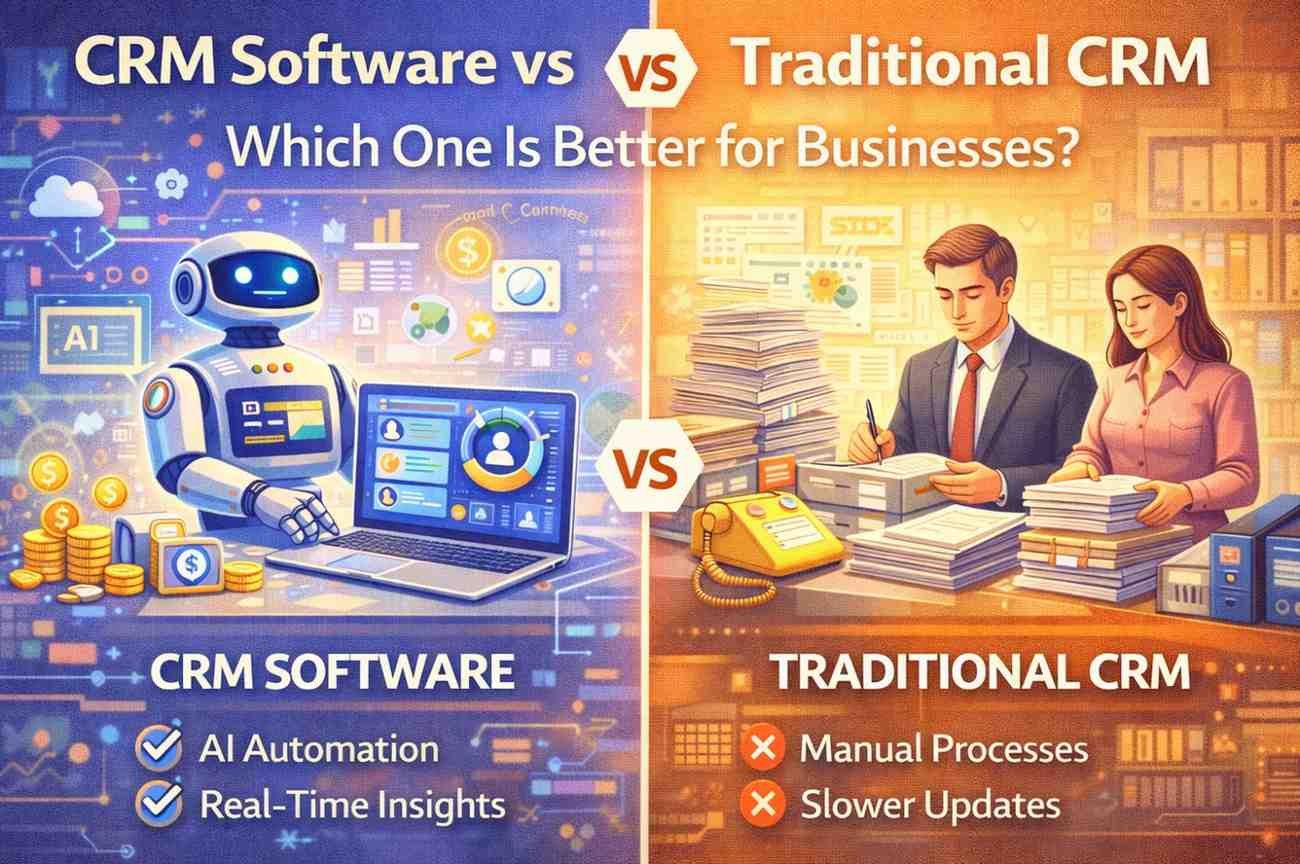
Today, many organizations are comparing CRM Software vs Traditional CRM systems to determine which solution offers better efficiency, scalability, and business insights. While traditional CRM methods focus on manual processes and basic data management, modern Customer Relationship Management Software integrates automation, analytics, and cloud technology to optimize business operations.
What Is CRM Software?
CRM Software is a digital platform designed to manage customer relationships, track interactions, and improve sales processes.
Modern CRM platforms provide tools for:
- Lead management
- Sales pipeline tracking
- Customer communication
- Data analytics
Unlike traditional systems, CRM Software for Businesses integrates with marketing tools, email platforms, and sales automation systems to streamline workflows.
Key Features of CRM Software
- Automated lead management
- Customer interaction tracking
- Sales pipeline visualization
- Real-time analytics dashboards
These features make Modern CRM Software a powerful business management tool.
What Is Traditional CRM?
Traditional CRM refers to older methods of managing customer data without advanced automation or cloud technology.
Examples include:
- Spreadsheets
- Paper-based records
- Local databases
- Manual sales tracking
While traditional CRM systems may work for small businesses initially, they often become inefficient as companies grow.
Limitations of Traditional CRM Systems
- Manual data entry
- Limited analytics capabilities
- Lack of automation
- Difficult scalability
Because of these limitations, many businesses are switching to Cloud-Based CRM Software.
Step-by-Step Comparison: CRM Software vs Traditional CRM
1. Data Management
Traditional CRM
Customer information is stored in spreadsheets or manual databases.
Challenges include:
- Data duplication
- Inconsistent updates
- Limited accessibility
CRM Software
Modern CRM platforms store data in centralized cloud systems.
Advantages include:
- Real-time data updates
- Secure data storage
- Easy data access across teams
2. Automation Capabilities
Traditional CRM
Most processes require manual work.
- Updating contact records
- Sending follow-up emails
- Tracking sales leads
CRM Software
Modern CRM tools provide automation features such as:
- Automated email campaigns
- Lead scoring
- Task scheduling
Automation improves productivity and efficiency.
3. Sales Pipeline Management
Traditional CRM
Sales tracking is often managed manually using spreadsheets.
This can make it difficult to visualize sales progress.
CRM Software
Modern CRM platforms provide visual sales pipelines that allow businesses to:
- Track deals in progress
- Monitor conversion rates
- Forecast revenue
4. Customer Insights and Analytics
Traditional CRM
Traditional systems provide limited data analysis capabilities.
Businesses often need to manually analyze data.
CRM Software
Modern CRM platforms include advanced analytics tools that provide insights such as:
- Customer behavior patterns
- Sales performance metrics
- Marketing campaign effectiveness
5. Accessibility and Collaboration
Traditional CRM
Data is often stored locally, limiting team access.
This can create communication barriers between departments.
CRM Software
Cloud-based CRM systems allow teams to access data from anywhere.
Advantages include:
- Remote access
- Team collaboration
- Real-time updates
CRM Software vs Traditional CRM Comparison Table
| Feature | CRM Software | Traditional CRM |
|---|---|---|
| Data Storage | Cloud-based centralized system | Spreadsheets or local databases |
| Automation | Automated workflows and tasks | Manual processes |
| Sales Pipeline | Visual pipeline tracking | Manual sales tracking |
| Analytics | Advanced reporting and insights | Limited analytics |
| Accessibility | Remote access from anywhere | Limited local access |
Benefits of Using CRM Software
- Increased sales efficiency
- Improved customer relationships
- Better data insights
- Higher revenue growth
Common Mistakes to Avoid
- Selecting overly complex platforms
- Ignoring integration capabilities
- Not training employees
Avoiding these mistakes ensures successful CRM implementation.
Tips for Successfully Implementing CRM Software
- Define clear business goals
- Train employees
- Integrate with existing tools
- Monitor CRM performance
Conclusion
When comparing CRM Software vs Traditional CRM, it becomes clear that modern CRM platforms provide significantly greater advantages for businesses. While traditional CRM methods may work for very small organizations, they often lack the automation, scalability, and analytics capabilities required for growing companies.
By leveraging cloud technology and automation tools, organizations can streamline their sales processes, gain valuable insights into customer behavior, and build stronger long-term relationships with clients. Investing in the right Customer Relationship Management Software can provide a powerful competitive advantage in today’s digital business environment.